Iran has stated that it will not allow the United States to decide when the two countries should go to war or make peace. Four consecutive days without exchanges of strikes have raised hopes that mediation involving Qatar and Pakistan could revive the stalled temporary agreement.
“We will not allow the United States to determine the timing of war and peace,” Iranian Foreign Ministry spokesperson Esmaeil Baghaei said at a weekly briefing on Monday.
According to him, any decision regarding future negotiations will be based solely on Iran’s national interests, and Tehran will continue to defend itself “for as long as necessary.”
In an interview with Austrian television channel ORF on Sunday, Baghaei acknowledged that Tehran and Washington are continuing to exchange messages. However, he said that US military actions had destroyed the conditions for meaningful negotiations, and that Iran’s immediate priorities remain the protection of its sovereignty and territorial integrity.
Meanwhile, US President Donald Trump told reporters that Iran had requested negotiations “through intermediaries and directly,” claiming that Tehran is ready for dialogue because of the military pressure it has faced.
“We are conducting in-depth negotiations with Iran,” he said. “If they fail, we will return to a large-scale military operation.”
He said he responded positively to the mediators’ request to give diplomacy another chance, but he does not intend to allow negotiations to continue indefinitely.
“I have plenty of time,” Trump said, while insisting that Iran had “suffered seriously” over the past two weeks.
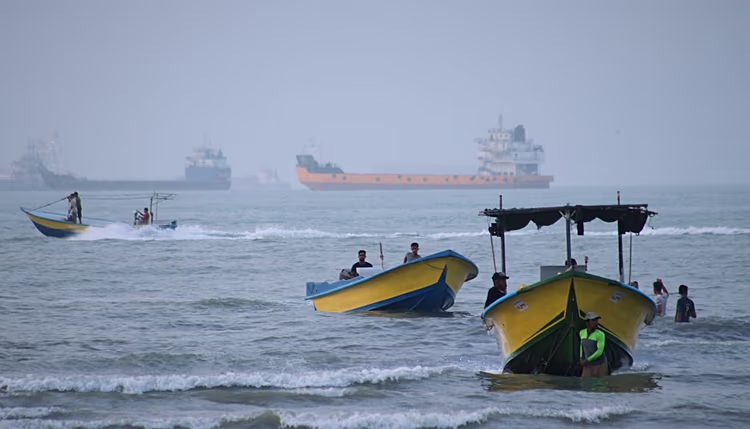
Despite renewed diplomatic efforts, the crisis surrounding the Strait of Hormuz remains unresolved.
Baghaei said that negotiations with Oman regarding the management of the strategic maritime passage are continuing, emphasizing that they are strictly bilateral and not connected with the United States.
“The Strait of Hormuz remains closed,” he added.
Deputy Speaker of Iran’s parliament (Majlis) Haji Babai stated that any agreements with Oman regarding the strait must not contradict Iran’s sovereignty and that Washington should not participate in discussions on this issue.
He stressed that Iran would not retreat from its position regarding the strait, noting that decisions concerning Hormuz would ultimately be made by the country’s leadership and its people.
The Strait of Hormuz, through which around one-fifth of global oil and gas trade passed before its effective closure by Iran after the start of the war on February 28, remains the main obstacle to reaching a settlement.
Iran insists that it has “sovereign rights” over the strait and the authority to determine permitted shipping routes. The United States, Gulf states, and most of the international community reject such claims, citing the United Nations Convention on the Law of the Sea (UNCLOS). Tehran signed the document but has never ratified it.